
Why are hotel gyms so bad?
The “fitness suite” is a fitness flop

I’m writing to you from Montenegro. It’s been a cool 37 degrees celsius this past weekend, and I’m here for work juggling a jam-packed schedule, hence the delayed Tuesday newsletter. I had planned to hit send on Sunday night, but a 6pm meeting with an Olympian and her husband turned into a late, long (and very fun!) dinner. The same thing happened on Monday. And so here we are.
To make up for my tardiness, I’m dropping a second story about how to pack for an active vacation using only hand luggage this mid week. Set your alarms.
I spoke with the Olympian about her workouts; the hotel we are in has an excellent gym, and I bumped into her at the squat rack yesterday. Gym hospitality has been on my radar for a long time, and on-the-road-fitness is becoming an obsession of mine. (I also wrote a piece for the FT about the world’s best ones a few weeks ago.) In this week’s Salty, I do a deep dive on why historically the hotel gym is so shit. I hope you enjoy.
Here’s a scene we’ll all be familiar with. We’re on vacation with time to workout, or travelling for work and want to stick to our routines. The hotel is nice, maybe it’s even a 5* one because it’s going on the expense account. The beds are super comfy, the rooms are very well-designed and the breakfast is great. The gym? Forget about it.
Going to a hotel gym can be a jarring experience. It’s as if stepping into the elevator and pressing the button for -1 GYM suddenly transports you—Severance-like—to the 1980s. You haven’t suddenly lost your memory but the hotel has instantly lost its shine. Upstairs, everything about the hotel is polished perfection, with gleaming surfaces, slick service and no guest request too inconvenient.
The gym is a different story. In there, it’s all about inconvenience. The machinery is all squashed together. The air conditioning feels non-existent. As does the vibe, because it’s a ghost town down there and there’s no music on. The water comes from an office-style machine with plastic cups, which then spills all over the floor when you knock it over during a functional workout. Likely, you're stationed in the middle of the room because there’s no real space for a mat routine. It begs the question, has the person responsible for creating this gym ever even been in one, let alone done a workout?
Another issue: most hotels don’t bother to try to make their gyms look good. Which is realistically no problem if the gym gives you a great workout — functionality over fashion, always — but it’s very surprising that hotels don’t try to maintain a cohesive, decorous vibe. Why put so much effort into every other space and just abandon the gym? There’s rarely images of workout zones on hotel websites for a reason. Hoteliers know they look awful.
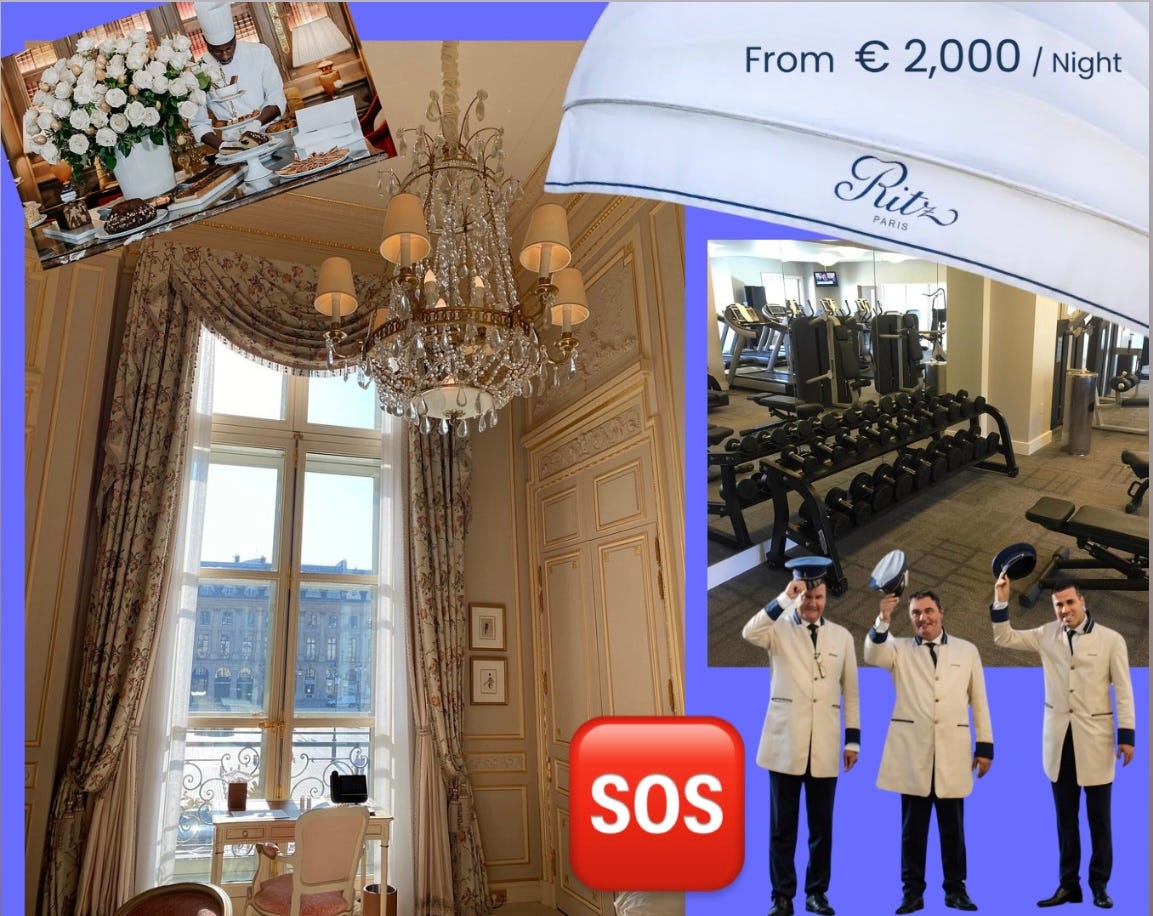
(Some nice contrast via Ritz Paris.)
The fact check
Last month, I stayed in a cute boutique hotel in Paris which claimed, online, to have a “fitness suite.” I packed my gym kit and in a stolen hour, I headed downstairs to do a weights workout. Only, I found myself in an odd, little wooden room. It reminded me of something you might find on Diagon Alley in Harry Potter.
Inside, there were mirrored walls and, in the middle of the floor, one wooden bike and a bench. A treadmill would have made it feel the size of Harry’s actual under-stairs cupboard. If a tall man had laid down for a full body stretch, he’d be pushed up against the walls.
In the corner was a €30,000 cable machine with what I could only gather were four sets of weights. They looked like giant leather bananas filled with sand, with wooden handlebars. If Jacquemus did dumbbells, I thought. It wasn’t apparent how heavy any of them were, but I estimated not very. I found it difficult to do anything with them. My hands slipped around the smooth wooden handle, and the wide shape of the weight made them feel destabilising. I later found they are called swingbells — a dumbbell alternative that alters your centre of gravity, and which you’ll find in no gym ever. Style over substance, and then some.
Last summer, I stayed in a really nice hotel on Broadway in New York. $500+ a night nice. (I was not paying.) My room was incredible, with a freestanding bath, lots of layered lighting and lamps that basked the room in a glow, and views of the city where I could people-watch pedestrians. The room service menu was delicious and arrived beautifully presented on a wooden tray. The gym, unfortunately, was really bad.
The setup itself was not good. The room was like a rectangular shoebox with a low roof, and it was painted dark so it felt even smaller — exacerbated by the fact the air conditioning didn’t seem to work. On one side was a dumbbells and mat zone, with mirrors, which was functional albeit uninspiring. On the other side, all cardio equipment was side by side facing a dark navy-painted wall. At the one window end, there was a cable machine that blocked most of the natural light. Can you imagine if a hotel room was furnished like this?
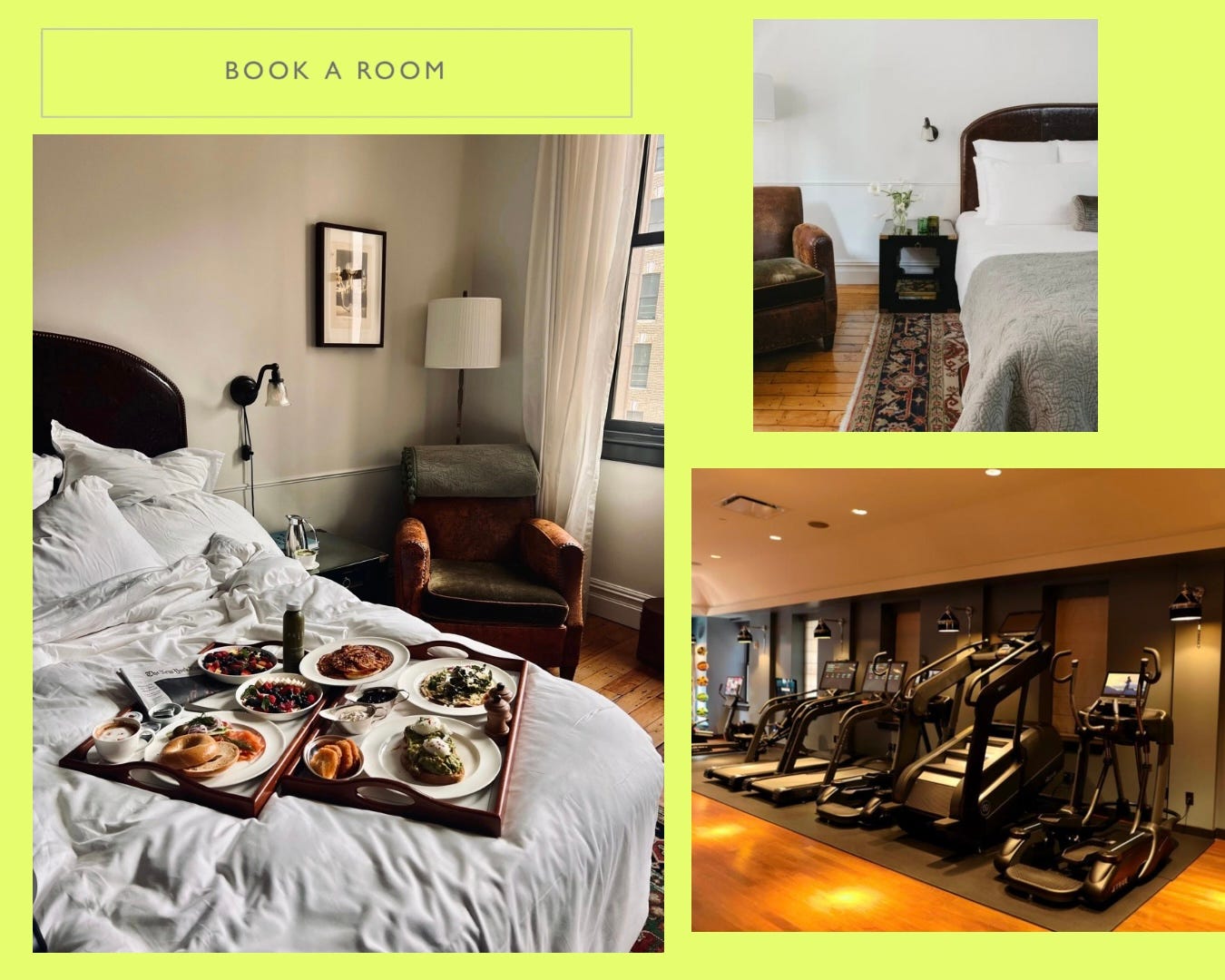
(Aforementioned New York hotel.)
The conflict
In the New York hotel, every other touchpoint across every floor was considered. Corners were accessorised; parquet floors were layered with gorgeous Persian rugs; walls were covered with commissioned original works of art. The vibe was warmth and tactility. It was cosy but elevated, and curated; there’s even an own-brand newspaper. It’s confusing that the gym has been neglected.
I’ve asked a few hotel CEOs why the gym is such an afterthought. Gyms typically aren’t part of an interior designer’s remit. A room is allocated, usually in an unused, unwanted cavern of the basement because it’s the cheapest real estate. Equipment is then bulk-ordered, often from Technogym™ because it looks cohesive and it’s a trusted brand.
People ordering the equipment aren’t experts in all things gym; it’s often a hotel manager. They rarely consult personal trainers on what equipment is best ordered for spacial and workout optimisation. A sign of a thoughtfully executed gym, according to Tim Blakey, a London-based personal trainer, is if the equipment is from different brands. It’s the equivalent of curating your house or hotel room, versus ordering everything in bulk from one shop. His real pet peeve is cable machines in tiny hotel gyms; he says few people really use them so they’re a waste of precious space.
The issue? The gym typically doesn’t bring in any money.
It’s not like the spa, where every treatment is an upsell. Equipment is expensive but gyms are free to use and open all hours, so it’s a loss-making zone. It’s not been a focus for hoteliers as the gym is the one place within a hotel where guests are self-sufficient. Chances are, once the machinery is in and the lights are on, management just forget it’s there; there’s rarely dedicated gym staff.
“Fitness suites” can feel a box-ticking exercise. It can also feel like gaslighting once you walk inside and realise you’ve got 6 square metres to play with.
It’s interesting that a lot of hotels don’t think about the guest’s workout experience. If hotels did an exit poll of those leaving a fitness suite, I’m betting the 5* ratings would drop to a lowly 1*. Which is unfortunate, and short-sighted, because gyms are actually the place where guests properly interact with a hotel. We go otherwise go around with blinkers on.
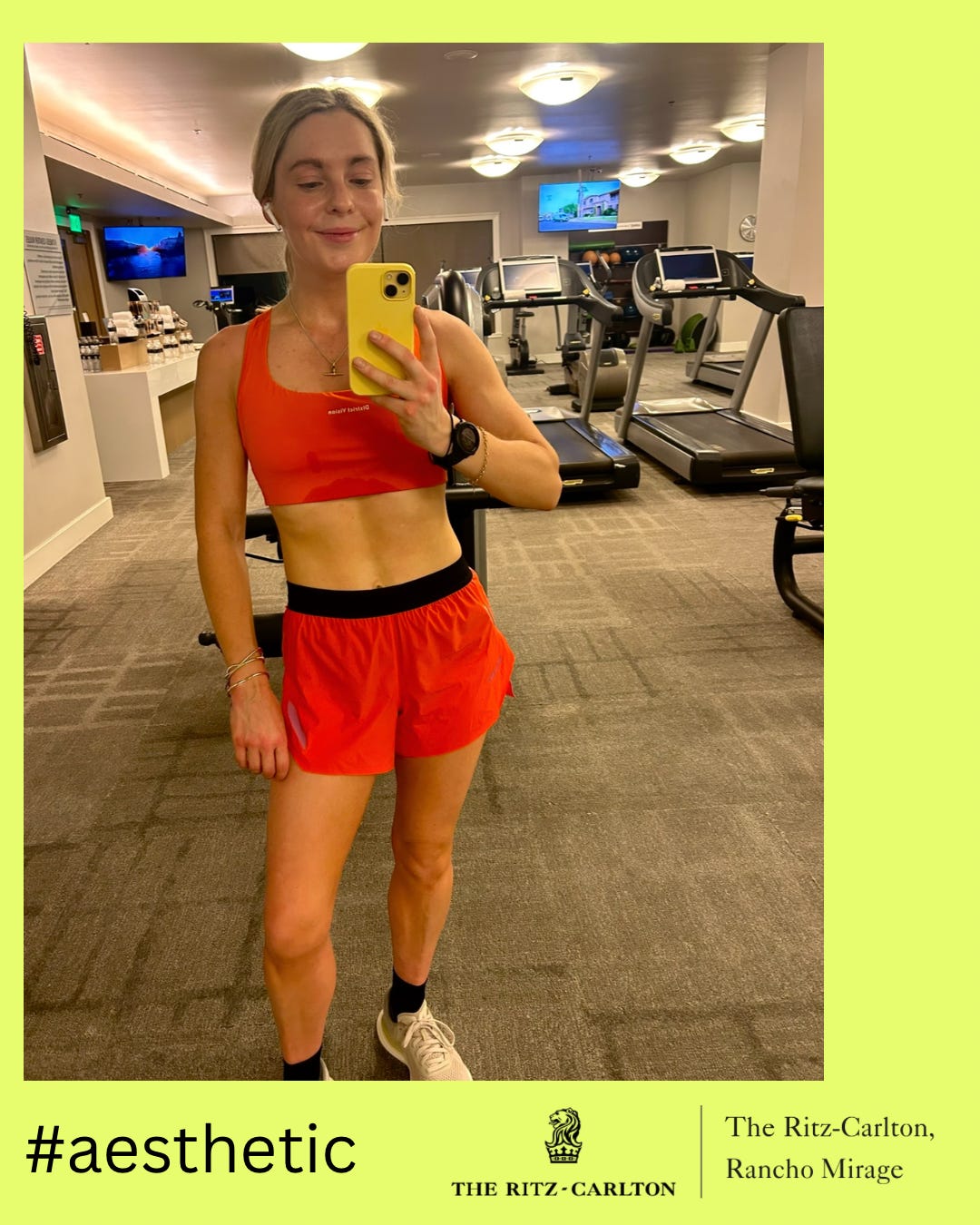
(At the Ritz Carlton in Palm Springs last year, which clearly hasn’t been updated since the 80s.)
We rarely spend time in our rooms to appreciate the thoughtful touch points. We don’t sit at the coffee tables in the lobby to admire the design books that were painstakingly chosen. We sit there on our phones. Even the breakfasts aren’t particularly memorable in the grand scheme. (Exception being that in Paris, I got served 1.5 peeled, boiled eggs one morning. What happened to the other half?)
Know what is memorable? Spending 45 truly interactive minutes working out in a gym that looks great and has an intuitive layout. That’s the stuff of peer-to-peer recommendations.
Also, the spa is dead
I’m calling it.
The spa has forever been the focus in hotels, but the percentage of guests booking in for a facial or a massage while they’re travelling must be very small based on overall guest numbers. The days of slow pampering are, I think, gone — especially in a busy, city hotel. People want functionality and maximum efficiency. People don’t really have enough time to slow down, lie still and have lotion put on their face; it’s not what we came for. Personally, I don’t think it’s a good use of my time. I would use the spa if it was for an intense sports massage, or cryotherapy, or hot or cold plunge. I would also use it for a sauna.
A hotel sauna is a serious flex. I’ve used the one in Montenegro most days. When I stayed at Siro in Dubai, I had 10 minutes to spare before my taxi picked me up for the airport, and I used it to have a cold plunge. Real ease of access to modern wellness is a proper hotel amenity.
My friend Sam is currently in Switzerland, and he sent me a photo of his hotel gym the other day. It was a cool, industrialist space filled with a woodway treadmill and other wooden cardio equipment. The jury’s still out on whether the gym is just a ‘fashion’ one or not; a woodway screams Hyrox but it’s harder (I think) to log some real miles on one of those. The real plus, he said, was a private sauna, cold plunge and social area that you ‘book’ for free for your room, in time slots of your choosing. Smart and unique.
Hotels need to evolve
Fitness and wellness are changing culture. Everything from the way we eat to the way we travel (and where we choose to stay) is funnelled through this lens. There’s a raft of new fitness focused hotels opening to meet this need, which I’ll be writing about separately. (Let me know if there’s any that should be on my radar.)
If hotels want to engage younger guests in particular, leaders need to realise what we’re looking for has changed. Young people want the smoothie bar; the pool with a view; the opportunity to workout. All the better if the gym looks sexy in the backdrop of mirror selfies.
The hotel restaurant needs to shift, too. Where are the protein-packed breakfasts and desserts on menus? Protein ice cream is all the rage on TikTok. Ditto protein pancakes with honey. Greek yoghurt with berries. Hoteliers need to realise that people travelling for work cannot (and do not want to) eat indulgently every single day. Better versions of typical ‘treat’ foods is something a hotel could become known for. List the macros on a menu. Show you’re in the know.
Plus, hotels need to stop focusing their energies on restaurants, period. They’ll ultimately become less relevant in years to come as Ozempic becomes more commonly used, and patients (or micro dosers) eat and order less. GLP-1 users need to use the gym to stop muscle waste, too.
Workout zones are more important than ever. It’s time hotels honed in.
As ever, I love to hear from you! Please leave a ❤️ at the top of the email if you liked this, and drop a comment with your thoughts. It boosts my ratings and helps other readers find me!
You can also email me on saltysubstack@gmail.com
This February my partner and I went to New York and stayed at a relatively decent hotel in LIC (nothing too fancy but with nice rooms etc). It was -15 outside, a 10k race we randomly signed up for got cancelled because of icy roads and we were keen to do a physical activity. Suddenly we noticed in the elevator a sign saying there was a gym on -1 floor and I said: “Hmm that’s strange, it wasn’t advertised on their website”. We thought, let’s give it a go. We changed into gym clothes and my partner went downstairs first. He texted me:”Do not come here”. If only I could show the photo. But you could just as well Google a dungeon and it wasn’t very far from that!
Hard relate to all of this! When you said you were in Montenegro I immediately wondered if you are at the new Siro as like you I stayed at the one in Dubai and it set a new standard for hotel gyms (even though it really is a gym with a hotel).
I find St Regis/Westins have decent enough gyms so I try to stay there for business trips but as daily workouts are my non-negotiable I always choose a hotels based on their proximity to boutique fitness studios like Barry's where I know I can do a drop in, the team will welcome me with big smiles, and I will get a seriously good workout.
One London hotel I am curious to try is the new Mason & Fifth at Westbourne Park which has a wellness space with pool, gym, and classes, I am curious to see if it delivers!