

I got plagiarised. Again.
A floating head "brand strategist" on Instagram turned my story into a viral reel. I went to war.

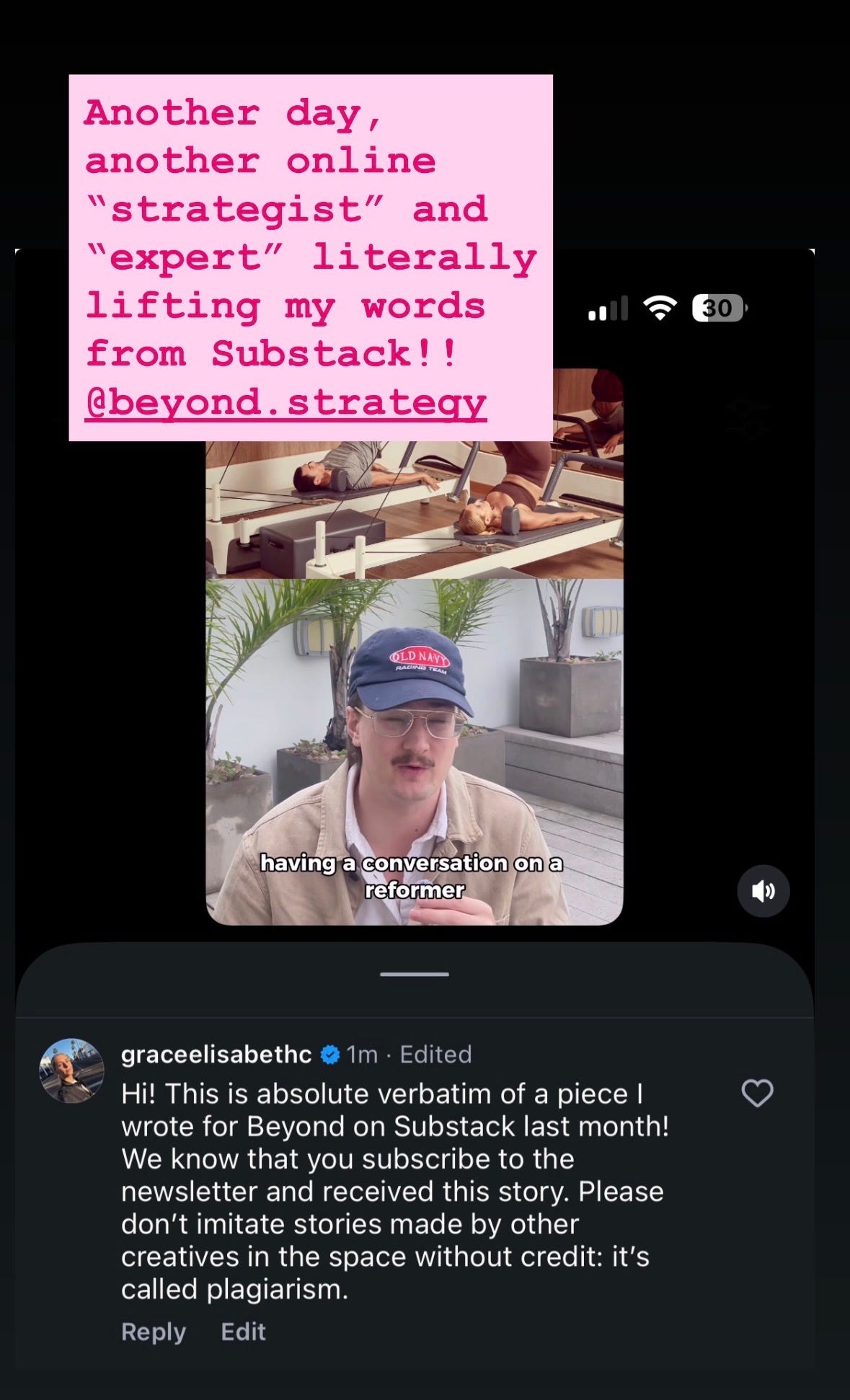
Hello everyone. It’s 4am on Tuesday, and I cannot sleep. Yesterday, a piece of work was blatantly plagiarised by a floating-head “brand strategist” on Instagram. The story was about women’s golf, which I co-wrote with Beyond—a women-owned insights studio which conducted extensive global research in the field. Our angle was that it was the next Pilates. This floating head lifted his entire script from the story verbatim, and turned it into a reel that got him over 90,000 views and 5,000 shares within a couple of days. Yes, he subscribes to the newsletter. Yes, he’d read the story.
The Beyond team—a hyper-talented power duo—alerted me on WhatsApp. Honestly, I saw red. Not only because this is the millionth time that this has happened to me, but because this time, it wasn’t only about me and my work. Their research, statistics and information gleaned from their on-the-ground interviews had been lifted by some dude in his 20s who was also plagiarising my lines and angles about hot girl walks and reformer Pilates—and the rest. He proffered them as his own insights, as people today feel so entitled to do.
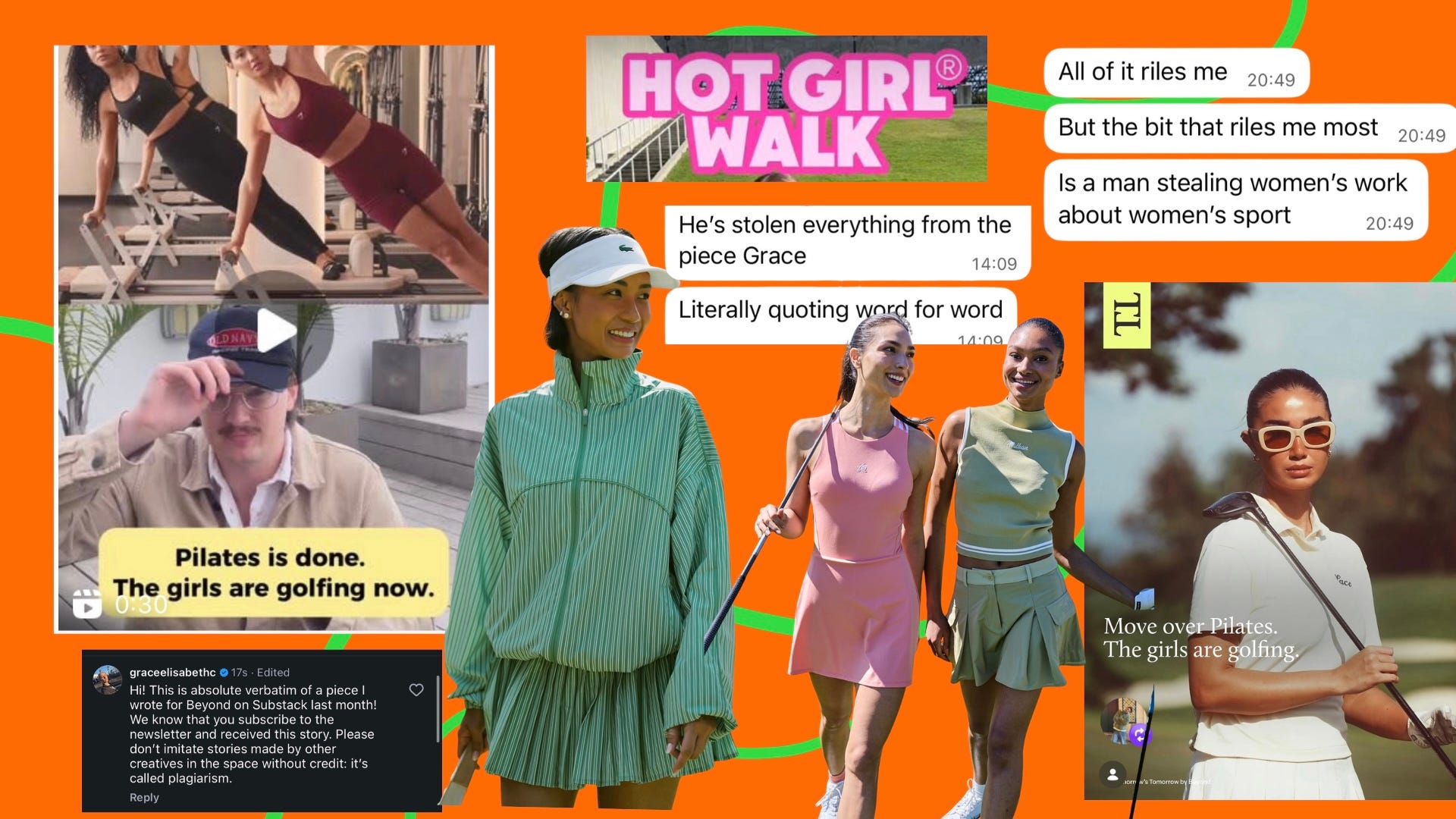
I was aggrieved for both of us. But it’s more than that. Nicola, Beyond’s co-founder and director, was among the first people to support Salty. I remember the day she subscribed, because she upgraded to paid straight away, and she was one of the first strangers to do so. That same day, she sent me an email saying she needed to find a way for them to “work with you and your mind.” I remember feeling very seen, respected, and valued. She actually did hire me for a consultancy project shortly after, and that was the start of not only our professional relationship, but also our personal friendship.
The Beyond team are women who support other women; their business supports my small business. The way they engaged me should also be the playbook of how we should be working today. Unfortunately, this is not usually the case. It’s increasingly common for strategists, marketers, brand people, PR’s and even editors and other writers to find inspiration, direction, strategy and insights on Substack, but most do not hire the source of inspiration for work. Most do not have paid subscriptions to the newsletters of those they lift ideas from.
Just last week, Carson Griffith of Rich People Shit posted about reporters who subscribe to RPS as a “feeder for their own ideas and stories”. I have lost count of the number of ideas, stories, and angles of mine I’ve seen replicated, so we exchanged a few comments about it. What became clear is this: people are lifting ideas and angles from Substack as if it’s Wikipedia—a bottomless pit of free-for-all resources. As if someone else’s IP is an instant gateway to another’s own benefit. People profit off another person’s thinking more than ever.
It’s not reserved for Substack. Stories from media titles get imitated all the time, by other publications and also by strategists and online floating heads and LinkedIn warriors. My Marathons As Fashion Week story got plagiarised by the Business of Fashion, followed by strategists, brand consultants, etc. My terminology became the vernacular and a strategy that the industry still use today, but only a couple of people actually credited me.
Citation really matters. One unaccredited post on LinkedIn was engaged with and reposted by executives from Balenciaga and other luxury brands in Paris. Those are influential people working within influential businesses. And as a writer, you don’t get paid more money if your story goes viral; a newspaper does not offer pay-per-clicks like YouTube. I got paid a £400 flat fee for my story, which was used by running brands big and small in their strategies. Others (strategists, writers, Instagrammers) have continued to benefit commercially from it.
Copying someone else’s IP has become common in today’s culture. It’s both interesting and concerning because people are getting hired, but rarely is it the person who created the original piece of work. There is a knock-on effect of that: loss of earnings, status, visibility, and credibility. You can’t account for missed opportunities if they never tracked back to you to begin with. We need to stop casualising this as normal practice. If this dude wound up winning an account off the back of that reel, his “borrowing” would have had a direct commercial consequence.
It even happens within Substack itself, despite the platform literally being set up for citation via restacking and tagging. It’s especially bad on LinkedIn. The thing is, in these instances, it is so easy to give credit so it’s an intentional choice when people do not. All it would have taken was for this guy to say in his reel where all his material came from, and Beyond and myself could have benefitted from the virality. He didn’t do that.
I increasingly see writers complain that legacy titles have lifted their ideas and work. It’s quite easy for a journalist to interview the person whose work they read on Substack as part of their story, and even promote that person’s Substack within their piece. If you’re getting paid to write someone else’s idea, I’d say that was a given. As someone who knows how transformative media placement is for brands and businesses of all kinds, I would love for Salty to be mentioned in the media. As a writer, that is not something I am able to do myself because it’s considered self promotion and a conflict of interest.
If someone else’s thoughts, reporting, network or insights are useful to your job, credit should be a baseline. If you return to a person’s work regularly for professional inspiration, a paid subscription is a small but meaningful way of recognising its value—especially when the cost can usually be expensed as a work resource. If your company can’t hire the writer to consult or do paid work for you, those £5 a month fees are not huge. But for independent writers, those subscriptions add up.
Salty is my incubator for ideas; you read my thoughts about everything here first. Every story I report first on Salty is a story I have chosen to write without the commission or fee I would get from writing for one of my titles. Writing is work, and time is not free—neither is a person’s perspective or ability to recognise and write about trends before everyone else does. Today, when people outsource even their Instagram captions to AI, an original point of view is arguably the most unique assets a person can have.
I understand the conversations that are happening on Substack about how expensive the subscription model is. We are in a cost of living crisis, and supporting every writer you love could equate to a person’s weekly food shop. I hope Substack does soon introduce new, more flexible ways for readers to support the work of those they value.
Support doesn’t only mean money, though. It could mean sharing a story, recommending a newsletter to a friend or making an introduction that might lead to paid work. We regularly post about a new restaurant we’ve eaten at, a new brand we’ve discovered, a new novel we’re reading, or a new workout class we’ve tried. People are often less instinctive about publicly recommending or sharing something they enjoyed reading or which changed how they thought about something. Those recommendations matter because they make writers in particular less vulnerable to shifts in the algorithm.
Visibility is currency today, and it is no longer separate from a writer’s or a creative’s livelihood. It’s not enough to be a good writer any more. Visibility affects who gets hired and who gets credited; it affects who gets a seat at the table, who is deemed to be most qualified for the job or who is deemed worthy enough of a project, including a book deal. People with high followers (or engagement) are deemed more capable than a person with fewer, often regardless of talent.
In two days, some 90,000 people saw this dude’s reel about golf being the new Pilates—that’s 180,000 eyeballs who saw him promoting our work as his own. Salty has never had 90,000 people reading a single post. To make it even more frustrating, his other recent videos had not broken 2,000 views total. What drives engagement today? Headlines and an angle. The things that he directly plagiarised from me.
This post is about what happened to us, but it isn’t only about us. It’s about the consequences of treating other people’s minds and IP as an endlessly open resource—particularly when the algorithm gives greater visibility to the person who borrowed it, rather than the one who created it. If ideas are continually extracted from independent writers without credit, any future work, payment or opportunity cannot find its way back to them. Eventually, it becomes impossible for us all to sustain.
It’s very awkward for me to talk openly about this sort of thing. For women in particular, publicly calling out another person and backing the value of your own work carries risk. Women are too often labelled difficult, or arrogant, or unstable. Women have been taught to minimise ourselves and the value we contribute. Society has conditioned us to not talk about the financial reality of life and work. It’s a way of keeping us small, and I don’t want to subscribe to that notion.
This week, a man stole our work—work produced by women about women’s sports. He had the audacity to do so, and indeed, society has always enabled men to do so. Internet virality ratifies the reward. The algorithm tells people every day that publicly available information is fair game, and that repackaging someone else’s work is par for the course for content creation, product launches, et cetera.
A while ago, I wrote about imitation culture online and how we were taught at school not to copy another person’s homework, but today, we do it en masse and call it culture. There’s a reason all activewear looks the same. You can read it below.

Today, I decided to call it out. I was encouraged by the friends that did message me, those who offered to report it and those who did comment on the post. In the end, he credited us. He then finally complied with our request to take the post down. Today, we won.
I’m grateful that, in an era of mass disillusionment online when so many things feel hopeless, we still believed that this was worth fighting for. There need to be some new rules of engagement created around how people work together, take inspiration from each other online, and promote work that we love. It’s a Wild West out there at the moment, and we shouldn’t all have to subject ourselves to being a floating head on Instagram to get noticed, credited, and paid.
Writing Salty is my favourite part of every single week, and I’m grateful to all of you for reading it, sharing it, and for understanding that there is a person—and a lot of work—behind the newsletter that arrives in your inbox every week.
Thank you for being here. ❤️
Ninety thousand views turned this from bad manners into economic harm. Each one was an opportunity for the work to lead back to you and Beyond; instead, it built someone else’s authority. Credit is not decorative here. It is how reputation, clients, and income find the people who did the work. I’m glad you fought it and won.
Well done for calling this out Grace. The amount of work that we put into reporting on stories that are then just diluted into someone else’s reel or carousel… depressing. Also surely v naive on his part to think that your algorithm wouldn’t immediately show you a reel that had lifted your own story lol.