


Hello everyone. If you’re in London this weekend, you could have spent three days going to marathon events without getting anywhere near the start line. This week’s issue is a deep dive on why.
It’s Salty’s first birthday! I launched this newsletter a few days before the London marathon last year, and I have not stopped since. Salty has become such a fundamental part of me that I can’t believe it’s only been a year.
Salty has found readers from all corners of the globe, with subscribers in 50 countries and counting. Thank you all for being here, especially those who support it financially. Independent writing isn’t free, and it can only exist if people back it.
I was part of an incredible conversation with four other journalists this week, and we spoke about running media and the future of media more broadly. I’ll write more on this in the weeks to come, but something we kept returning to was the importance of investing in writing. Online culture has meant people got used to free content. If you find value in our work, please support by upgrading your subscription, buying the indie magazine or the book from your favourite Substacker.
If you work in the running space, and use writers’ work in your strategies or business proposals… a message on behalf of all of us, please upgrade to paid. New media is an expense-able spend, just as old media is.
I celebrated Salty’s birthday with an 8am breakfast with friends. It was such a treat to have a midweek meeting. For the first few years of my career, I barely made enough to pay my rent, so I would go to breakfast meetings with assistant PRs a few times a week. None of us had any money, but they had a corporate card, so we’d go somewhere fancy and all get fed for free. It was our job to build relationships with each other, but many of us became IRL friends; some of my most meaningful relationships today were forged over expensed eggs. (Hi Steve!)
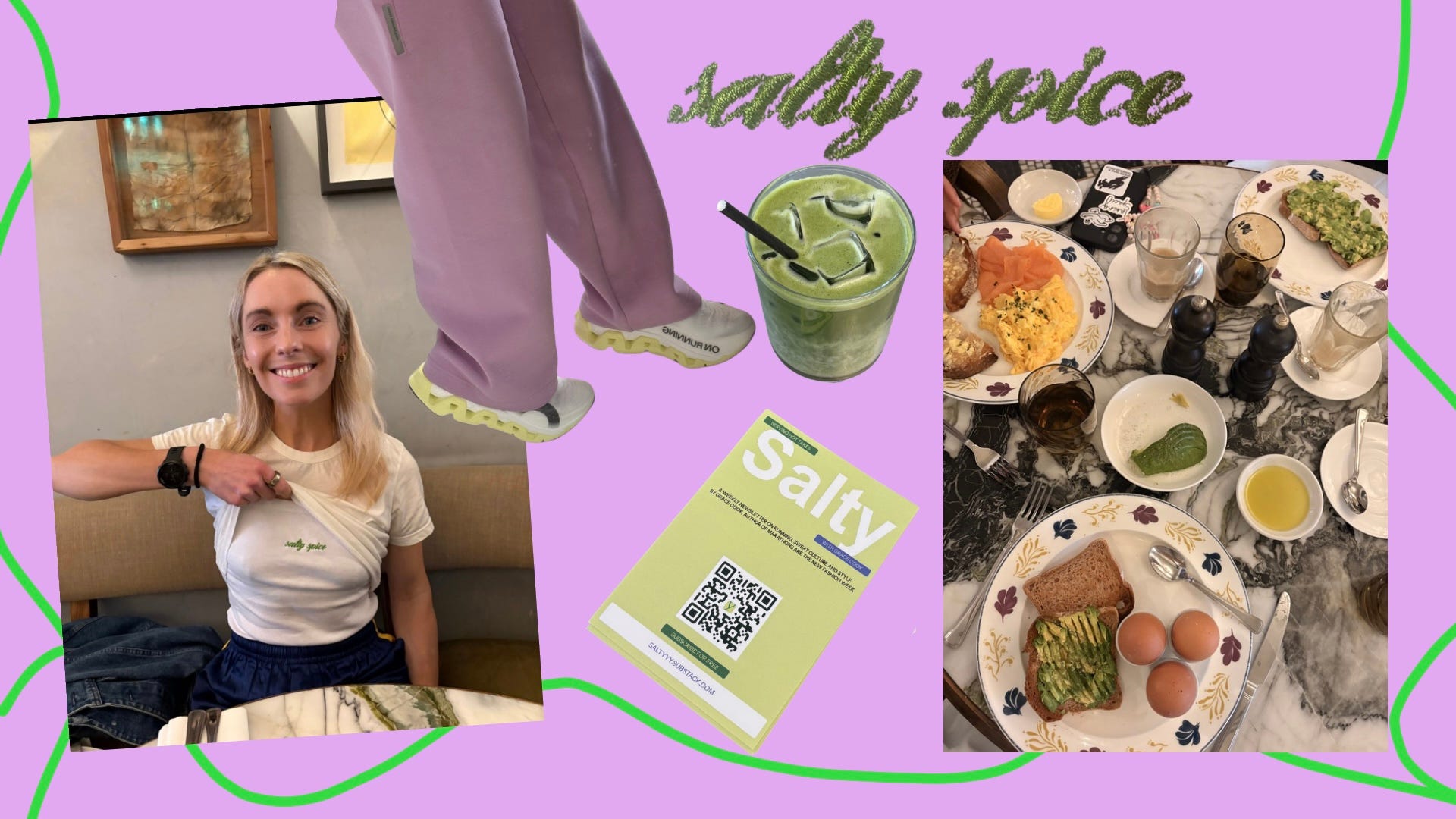
It felt really special to have my own Salty eggs date this week. It’s important we take those moments to acknowledge our own hard work, and share it. To celebrate, I wore my customised Salty Spice tank top. I got a DM on Instagram from someone asking if they could have one. Does anyone else want to be Salty Spice?
My debut letter asked if we’d hit peak run. It was linked to Nike’s RunTown, its larger-than-life marathon activation. I was the second person through the door and Salty offered the first deep dive. This week, I’m returning to the scene to bring you an up-to-date pulse check on. Here’s what’s happening on the ground.
WHO IS A MARATHON FOR, ANYWAY?
Today, it’s hard to miss the boom in marathon culture; even if you don’t run, you can’t escape it on Instagram. It was the Boston marathon on Monday, and the London Marathon is today. In fashion terms, this week is like the changeover between Milan and Paris Fashion Week.
Two years ago, I wrote a viral story for the Financial Times about how marathons have become the new fashion week. People now use this phrase within regular conversation; my point of view has become common parlance. People use the phrase to me in conversation all the time, without realising I wrote it; it happened to me twice yesterday. It’s surreal and cool to have coined the phrase that has come to make sense of the culture.
I’ve been writing professionally for 13 years and writing about running for four; I come at running culture from an outsiders’ perspective, observing the changing trends, ideas and feelings from grassroots to the head of brands and organisations—my career and my personal interest has given me access to both. I run with my friends and experience it as a customer, but I also have the head of brands on speed dial. Both inform my POV.
Last year, I wrote about whether we’d hit peak run. The fanfare around the marathon was deafening: brands and strategists who had read my marathon as fashion week post had, I hear, worked my reporting into their planning. But runners were on the cusp of fatigue. Lifelong runners dislike the new popularity of running, period, but newer runners themselves were getting burnt out.
This year? I think that the need for quiet is louder than ever.
Those in London this weekend know that there is no shortage of marathon events to go to. Even Apple has rebranded the front of its Regent Street store with a big marathon-related advertisement for the Apple Watch. Atis launched a marathon salad in partnership with Runna. Arc is offering free sauna and cold plunge sessions for runners on Monday. There’s free pints, free pizza, free smoothies, and shoppable merchandise galore.
Brands use the marathon window to launch new products with an IRL event. On just launched its new Cloudmonster 3 Hyper with its robot installation in central London and held several invite-only panel talks, and Adidas unveiled its new Adidas Evo SL 3.
Brands and businesses are not bored of the “marathons are the new fashion week” formula just yet; it’s great ROI for social. But people are increasingly tired of noise.
With more choice comes time constraints and the increased feeling of overwhelm; it’s literally not possible to go to everything, and attempting to execute your own marathon schedule is genuinely akin to scheduling a fashion desk’s show invites. Trust me, it was once my job to do that. I think we’re at a really interesting crossroads where race weekend pop ups will need to have a different purpose than engaging those who are racing. Marathoners are staying off their feet in prep—they need to relax, and sleep.
The formula is becoming unsustainable, and it can feel hollow. This bigger is better mindset that has been adopted en masse means brands are constantly needing to one-up themselves year on year; marketing budgets must be out of control. I’m half expecting someone to launch a rocket ship in the Grand Palais like Karl Lagerfeld did at Chanel. In an era of online chaos, I think more than ever, people are looking not only for curation, but meaning and connection. Bigger doesn’t equate to depth. Thoughtfulness might promise it.
Here’s why. The essence of a 26.2 mile race isn’t the culture you see on social media. A marathon is about people pushing their limits and doing really hard things… To me, the truest expression of that is in the tens of thousands of people who are running to raise money for charity. It’s people who are typically “not runners” doing something that is well beyond their norm for a good cause. Last year’s London race raised £87.3 million.
Brands’ explosive showcases can feel misaligned. I’d love to see them bring elements of charity into their marathon setup; to fundraise as well as focusing on bottom-line sales.
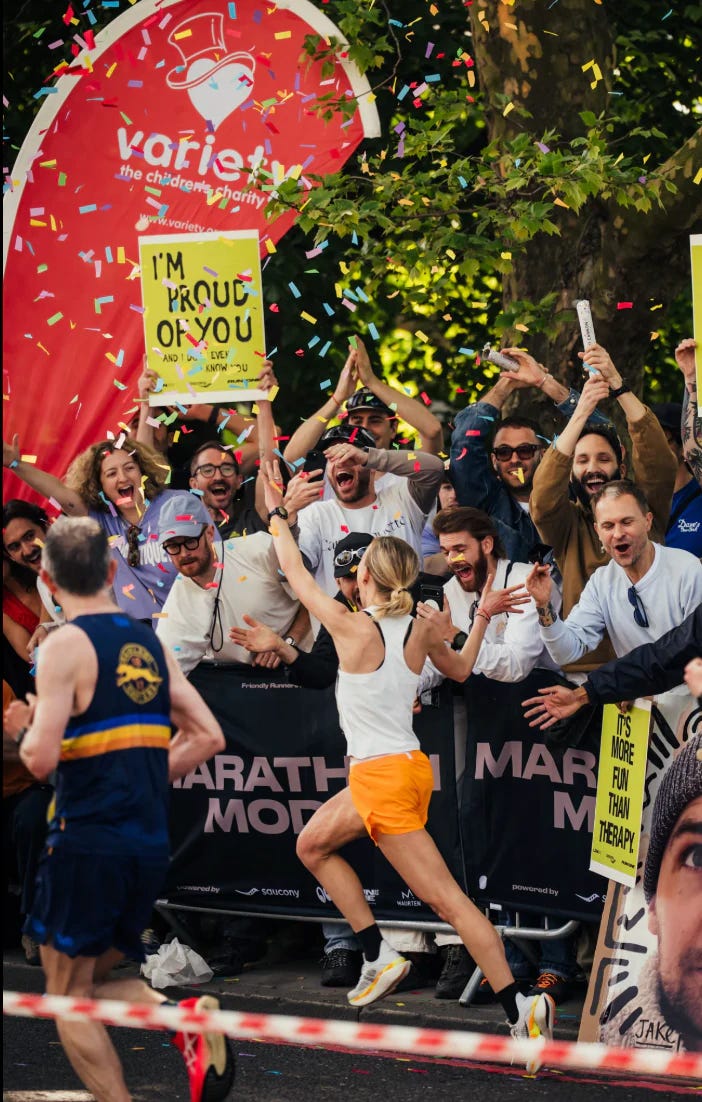
My friend Alex, running past my friends during the London Marathon. Her race would have been much flatter without this glory moment and the energy they brought.
Another take: brands need to create events that cater to the crowds, not only the participants. I would like to see pop-ups where people—anyone—could actually spend time and have an experience. To me that happens via hospitality. Last week, I had a piece published about whether Nike or other sports brands should open a hotel. (Answer: a resounding yes.) In pop-up format, for race week that could look like a Nike gallery, an Adidas cafe, or a lecture hall that brought voices across industries and related businesses together. People need intellectual stimulation.
I think it needs to become less about product, and more about experience. Merchandise needs to become ephemeral and less wasteful. Knees Up in Hackney (disclosure: it’s owned by my friends) always offers limited-edition marathon drinks. Last year, it was a marathon chocolate milk, this year, an iced cola slush. It also held a “race rejects” block race for people who didn’t get into the marathon. People can go there to feel a part of the weekend.
There were new shoots of this at this year’s London race. The smartest activation on the calendar this year: Bandit’s Ardith Singh held in-person sessions with Bandit customers, where she asked for feedback on existing fit and designs. She also asked runners what they wanted. Direct access to thought leadership is a persuasive reason to attend; the opportunity to influence the brand’s future collections is even more so. Connection + meaning = experience. 10/10.
Should the marathon focus on spectators?
A marathon simply cannot exist without the crowds. 55,000 people will be running the London marathon today, but more than a million applied for the ballot: there’s enormous ROI in engaging these people. Wouldn’t it be great if brands stepped back to reexamine what a marathon really means, and how they could show up in a way that was truly reflective of that? If events could make people who aren’t running feel like an important part of the weekend? If there was a charitable component?
Watching a marathon is special. I hadn’t ever spectated one before I started running; I’d run the London Marathon before I’d ever watched one. Running it was among the best days of my life, but my first experience cheering it was, too.
There’s a missing side to the marathon narrative that dominates social media and brand activations: the joy of being a bystander on marathon day. To stand in the crowd and cheer strangers with your heart should be prescribed by doctors and mandated at school. It is such a genuine expression of goodness, togetherness, and happiness. It allows you to tap into subconscious emotions and just feel.
A marathon is an emotional journey. I have run six of them by now, and I’ve felt more emotional watching other people run than I have ever felt for myself in participating. My friend Sarah told me this week she cried seeing me run over Tower Bridge a couple of years ago. I have cried when strangers who are walking and struggling have started running again because a stranger gave them the encouragement they needed to carry on. I saw a video from the Boston marathon this week, where two guys scooped up a runner whose legs had simply stopped working, and they carried him over the finish line. I cried.
Amid a turbulent world, with political and economic instability, global wars and social injustice, the news cycle is deeply affecting. I think many of us have become used to this feeling of daily doom. Doomscrolling triggers our central nervous system, and on social media, the dialogue from influencers on Instagram to keyboard warriors on LinkedIn has become so instructional, I often feel like I’m getting yelled at. If you want a temporary reprieve from all this, go and watch a marathon.
It’s an expression of absolute humanity—the significance of person to person relationships. Each cheer is an act of “I see you.” In a world where we can all feel increasingly disconnected and invisible, it matters. That overall feeling is addictive.
A huge amount of money will be raised for charity this weekend. Last year’s race raised £87.3 million. Yes, it might be annoying by now how many times you’ve been asked to sponsor someone; no-one has endless pockets and you can’t sponsor everyone. But a marathon cannot exist without kindness between people. Marathon activations are targeted at those who are running the race. But the race weekend is so much more than that.
It’s about spirit, and celebration. And people. Not just sales. Brands would do well to remember that.
I was in Boston last weekend and literally said to a friend that talking about which popups and activations we were going to felt like comparing which shows we were go to during FW!
Thought provoking post re what the large companies should be doing to give back rather than just profit. I can definitely agree re the emotion of spectating, I've travelled extensively to watch expensive sporting events but the London Marathon is by far my best spectating memory, and it has nothing to do with the elites, it's just the sheer scale and breadth of humanity that turn up to do their individual best, awesome.